Reading all of Dallas Wiebe’s writings, at least the short stories which are the bulk of it, can bring you to a place in which the variety in these fictions is experienced as chapters in one long novel (albeit one in which there are occasional digressions). Characters come and go over time. They mature, grow older and die. They speak in catalogues; of family connections; of towns and streets with those curiously comic Dallas Wiebe names, real places and invented ones, a geography in which most of these stories take place; of a great variety of political and social issues, and what emerges, even in the most disparate tales, is a kind of world view. It’s the literal view of Skyblue...
A Saudi woman received a death threat last week after she appeared on “Poet of Millions,” Abu Dhabi’s version of the game show “American Idol” — which features aspiring poets instead of singers — and recited a poem attacking clerics for “terrorizing people and preying on everyone seeking peace.”
Canadian poet Christian Bök wants his work to live on after he’s gone. Like, billions of years after. He’s going to encode it directly into the DNA of the hardy bacteria Deinococcus radiodurans. If it works, his poem could outlast the human race.
Kafka's Midrash on Jonah -Norman Weinstein
The sole way to avoid being swallowed upby the worldis to render yourselfindigestible.
Of course by doing soyou end upwith a worse fatesince when the earth refuses to swallow you, heaven must.
& since heaven, by definition, can digest nothing still resisting its stranglehold
you end up at the merciless world's mercy& will only note be digestedby concentrating every waking thoughtheavenward
So the faithless findfaithby turning away from all exit signs
Explore 1940s/50s Cleveland: the Jasper Wood Collection
Jasper Wood Collection:
Cuban Cigar Co.
A regular at the jazz spots on Scovill Avenue (Central/Woodland area) in the early 1940s, Jasper Wood was intimately familiar with the neighborhood's residents by the time he started taking their photographs in 1946. Click here to view Wood's extraordinary collection of photographs of this vanished neighborhood, including a rare photograph of noted American boogie-woogie pianist Arthur ‘Montana' Taylor, perhaps Scovill's most famous resident.
Mac's Backs Books and Bottom Dog Press invite you to a celebration of 25 year of independent publishing. The event will be held at Barking Spider Tavern in University Circle...5-7 pm...with pizza and poetry and music. Poets from the new Bottom Dog Press Poetry Anthologywill read from their work...The book has a poem from each of its 91 books of publication.
Poets who will be on hand include: Karen St. John-Vincent, Mary E. Weems, Ray McNiece, Meredith Holmes, Terry Hermsen, Marci Janas, David Shevin, Jennifer Burd, Michael Salinger, Maj Ragain, Rob Smith, Loren Weiss, Ken Meisel, editor Larry Smith...and Jim Lang reading for Daniel Thompson, and Michael McMahon reading for Russell Salamon.
I've heard a few comments lately about "making it". It made me think about what exactly it is we're making when we "make it". And what it means to "make it".
I think we most often hear this term applied to those in the arts--musicians, painters, writers, etc--in reference to being able to make a sustainable living at what they love. Becoming a household name, getting a song played on mainstream radio, making an appearance on Jeopardy!--whatever the specifics are, it usually means achieving a certain amount of fame and wealth. Maybe a modest amount, but certain amount nonetheless.
But poets, well, we're a special breed, aren't we? Or at least, we like to paint ourselves as such. But few can argue that poetry is as mainstream an art form as pop music. Very few--if any--poets achieve the rock star status enjoyed by some of those in other creative fields. Very few are even able to make a modest living at poetry. So does that mean that fewer poets "make it", or is our definition of "making it" different for poetry? Yet, we can probably spot those who definitely HAVE "made it". We probably agree that a Billy Collins or a Maya Angelou have "made it". But can you "make it" without reaching quite that high a status? Say, someone who received a Pushcart nomination? And is it even important to "make it"?
If you've spent any amount of time around poets in general, you've probably met at least one or two who don't believe in making money off of their art--maybe you're even someone who believes that yourself. Is there a way to "make it" in that case? Is "making it" even a goal? Do any of us ever expect to "make it" and work toward that goal, or is poetry just something we do for fun, community, socialization, release, art for art's sake?
Let me know your thoughts on what "making it" means to you, whether you're a poet, novelist, graphic designer, musician, teacher, data entry analyst....I'm curious. Humor me.
(So, now I know what the insecurity monster looks like! Or, at least, what Karen Sandstrom's insecurity monster looks like. Say, isn't it good to know that it's really only six inches high?
nb- click the images for a larger view of the artwork)
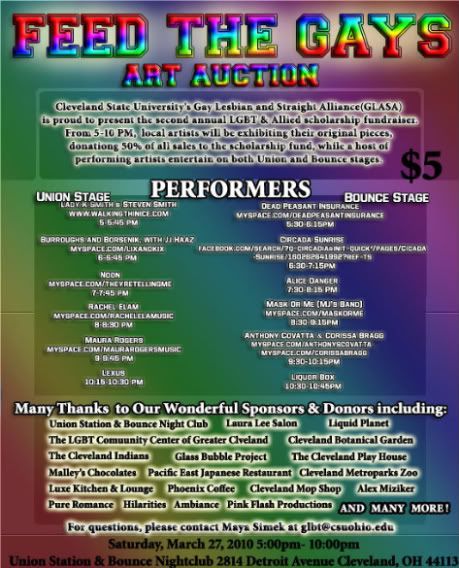
The Gay, Lesbian & Straight Alliance (GLASA) is a student group at Cleveland State University. On Saturday March 27th, GLASA will be hosting its second annual art show, Feed the Gays, to raise money for GLBT & Allied scholarships on campus (undergraduate, graduate law).
From 5pm to 10pm at Union Station and Bounce Nightclub (2814 Detroit Avenue in Cleveland), local artists will exhibit their work, donating 50% of all sales to the GLASA scholarship fund, while a host of performing artists entertain on the Union Station and Bounce stages. Among the scheduled performers: Cleveland poets Lady K & Steven B. Smith at 5 p.m., with Dianne Borsenik & John "Jesus Crisis" Burroughs (accompanied by 10-string guitar master JJ Haaz) at 6 p.m.
The cost to get in is $5, with all proceeds donated to the scholarship fund.
Native American poet and musician Joy Harjo will be at BGSU Firelands College Thursday March 25th...Come and hear her play and read her poems. She's a beautiful and engaged poet with a voice that speaks true. Free and open to the public...Firelands College is in Huron, Ohio...about 1 hour from downtown Cleveland...due West on Rte. 2...Then Rye Beach Road south half a mile. She'll be at the new Cedar Point Center on campus. Join us for an experience.
Last week I posted about writing prompts. As a comparison, here are some "prompts" suggested by the literary magazine Hawk and Handsaw: The Journal of Creative Sustainability:
2. Post Thoreau’s reminder: “the cost of a thing is the amount of what I will call life which is required to be exchanged for it, immediately or in the long run.”
3. Ask, what’s real? The problem, limits, available energies?
4. Ask, what matters? What do we need? What is worth wanting?
5. Toss the rules. If you need them, they’ll show up again.
6. Wander. Dream. Mull. Unfocus. Take walks in places where you don’t have to pay attention—but where moments of attention reward you with surprise or pleasure. Collect insights, both blinding and fleeting. Let them grow.
7. Use your left brain. Then your right. Left. Right. Left, right.
8. Ask, what will feed my energy, mind, heart, imagination, play?
9. Assemble a team of doers. Talk, eat and drink together, have fun.
10. "Do something. Take a break. Do something more.” -SueEllen Campbell, author of Bringing the Mountain Home.
Any of these ring your bells? Well, if they do, Hawk and Handsawopens for submissions on August 1. Get to it!
In an interview, poet Eliot Khalil Wilson discussed students who were horrified when he suggested a word change in the poems, not because he had critiqued them, but because they couldn’t use the change as it was his word and not theirs. Wilson’s reply was simple: “I don’t own the language.”
I find the idea of ownership of language a bit interesting, especially in the world of poetry, when the lines between inspiration, allusion and outright plagiarism are so easily blurred. For example, a common writing prompt given to students is to take a famous poem, break it down to its parts of speech, and then use that form as a sort of inspirational madlib to create a draft for a new poem. For example, taking the opening lines of “Disillusionment Of Ten O'clock” by Wallace Stevens:
The houses are haunted
By white night-gowns.
None are green,
Or purple with green rings,
Or green with yellow rings,
Or yellow with blue rings.
one would get
:article: :plural noun: :verb to be: :adjective/past participle:
and then fill in the blanks, focusing on a completely different topic than Stevens, but using his phrasing to create a new piece. The purpose of this prompt, of course, is to teach students to think in terms of phrasing, and to explore non-formal phrasings which clearly work and get them to ask why or how they work. Also, lessons like this teach the importance of word choice with in a phrase, line and poem. This sort of exercise can produce some very stunning poems; however, no matter how successful the new piece, there is still a dependence on the original poet and his or her line breaks, phrasing, etc. Has the second poet, then, stolen from the first in some way?
Another example would be poets who take a line or stanza from another poet, and then create an entirely new piece based on that line. Sometimes the line is used as an epigraph, or the opening line, or imbedded in the poem itself in quotation marks and possibly a footnote acknowledging the original author. Sometimes, though, there is no acknowledgement at all. Has the second author, then, stolen something from the first?
I am brought to the idea of jazz music, and things like covers and standards. These are tunes that are famous for the fact that their multiple versions and interpretations, no two alike. They are widely known by jazz musicians and enthusiasts, and need no acknowledgement beyond, perhaps, a liner note. No one in the jazz community, for example, eschews Miles Davis or Ella Fitzgerald for their versions of Thelonious Monk’s “Round Midnight,” but appreciate and celebrate the aspects which they brought to the piece. In the same way, as a poet who has lines taken for inspiration, I do not begrudge the poets who have used my lines for inspiration, but take the compliment and celebrate the new takes which those other poets bring to the words.
On the other hand, as a poet who has taken lines and phrasings from other poets, I do not feel as though I am thieving from those other poets, but simply adding my take to their standards. To extend the metaphor, I am simply taking their basic chord progression or melody and adding my own nuances to it to create an entirely new piece. Either way, no crime has been committed.
At what point, then, does this become an issue? I’m thinking here about certain ideas like Cut-Ups and Found Poetry. Cut-Ups are literary aleatorisms based on the destruction and reconstruction of other texts. In the most basic form, a person takes a text, such as a page in a book, and literally cuts it into four pieces, then rearranges those pieces to create a new text based on disjointed sentence structure and new combinations of language. It is a technique popularized by William S. Burroughs and Brion Gysin, but can be traced back to experiments by surrealist artists in the 20s and 30s. The issue, of course, is whether or not this new piece can, in anyway, be considered a theft from the original text or author? To what point must the text be deconstructed for it to be considered an original piece. For example, what if I take the following passage from Ecclesiates:
Vanity of vanities, saith the Preacher, vanity of vanities; all is vanity. What profit hath a man of all his labor which he taketh under the sun? One generation passeth away, and another generation cometh: but the earth abideth for ever. The sun also ariseth, and the sun goeth down, and hasteth to his place where he arose. The wind goeth toward the south, and turneth about unto the north; it whirleth about continually, and the wind returneth again according to his circuits. All the rivers run into the sea; yet the sea is not full: unto the place from whence the rivers come, thither they return again. All things are full of labor; man cannot utter it: the eye is not satisfied with seeing, nor the ear filled with hearing. The thing that hath been, it is that which shall be; and that which is done is that which shall be done: and there is no new thing under the sun. Is there any thing whereof it may be said, See, this is new? it hath been already of old time, which was before us. There is no remembrance of former things; neither shall there be any remembrance of things that are to come with those that shall come after.
and cut it into quarters, and rearrange it as a poem using minor edits and line breaks:
Rivers come, thither they return
again. All things are full of vanity
saith the Preacher, vanity of seeing,
the ear filled with hearing, the labor
which he taketh under the sun. One
which is done is that which shall be
done: and but the earth abideth forever.
The sun also: whereof it may be said, See,
this is new? It hath where he arose.
The wind goeth toward the south, and there
is no remembrance of former things; neither
shall the wind returneth again according
to vanities; all is vanity. What profit hath a man
of all his sea not full: unto the place from whence
the generation passeth away, and another generation
cometh of labor; man cannot utter it: the eye
is not satisfied, and the sun goeth down, and hasteth
to his place thing that hath been, it is that which shall be
etc.
Ignoring the weak line breaks and lack of craft in this piece for the sake of example, have I stolen something? While the KJV is not a copyright text, what if, instead, I took a paragraph from Seth Grahame-Smith’s “Abraham Lincoln: Vampire Hunter” and did the same thing? Have I created a new poem or have I committed a plagiaristic crime?
Found poems are even more tricky. In a found poem, the poet simply lifts entire words, phrases and sections from another text (usually not a poem), then frames them as poetry using minor word changes and line breaks. A great example of this is Hart Seeley’s “The Poetry of Donald Rumsfeld,” which takes exact sentences, word for word, from Rumsfeld’s speeches and presents them with line breaks as poetry. Has Seeley stolen from Rumsfeld? What if, instead of political speeches, Seeley had chosen a literary text under copyright? Would the inserted line breaks be enough to create a new work?
I am encouraged by Eliot Khalil Wilson’s thoughts that one does not own language, but I’m also trepidacious when it comes to submitting the successful results of more experimental forms like cut-ups and found poems for publication. As a poet, I don’t make enough money to get sued, but do feel that I have created new texts based on current works that, thought they maintain some allegiance to the original text, are unique enough to stand on their own. I’m curious to know where others stand on these sorts of issues or if anyone even thinks about them at all.
I've been involved with the Cleveland Literary Center ("the Lit") off and on ever since back before they even were "the Lit," when they were merely the Poet's League of Greater Cleveland, a cantankerous group of old (and young) poets that didn't even really like each other, but did agree that, somehow, poetry was important, and needed to be nurtured and heard and read and promoted. Joanna Connors had a good article in the Plain Dealer summarizing the history of the Lit, where they've been and where they're going from here:
Check out their site, as well their literary journal Muse. Or join them on Facebook.
And, a message from the Lit:
Mark your calendars! The LIT’s 2010 Biennial LITerary Awards will take place on September 11, 2010 at The Ohio Theatre in PlayhouseSquare. Visit our Awards Page for information on Submission and Nomination Guidelines.
I should also note that this is only one of many events that the Lit hosts. Coming up on March 27th, for example, they will be hosting Green Panda's benefit event "Saturday Night at the Parthenon" at The Lit on Superior --but Bree will probably blog about that later, I expect.
At the risk of permanently sullying my somewhat spurious reputation as web-savvy by sailing into cyberwaters I have no experience navigating, I need to ask: does anyone know where I can find a copy of Google Calendar for Dummies? I'm trying, but I just can't figure out the damned application. First, I wanted to make a couple of corrections in the calendar widget in the left sidebar of this blog (e.g. Lix and Kix is now on Wednesdays, not Tuesdays, and the Deep Cleveland Poetry Hour begins at 8:30, not 9:30). I also wanted to add a bunch of new events to the widget - to make it a comprehensive listing of all Cleveland area poetry happenings. But when I log into my Google account and add events, they only show up on my "personal" calendar, not here, though I'm (obviously) an authorized author on this blog. How do I get them to show up here? I should probably ask our beloved blog moderator - but I don't want to bug him while he's out of town (if I were in Shanghai, I wouldn't want you bugging me, either, especially with blog minutiae). I'm also thinking that, since no one else has added events to the widget lately, I'm not alone in finding the workings of this Google Calendar thingie incomprehensible. Here's hoping one of our cybersavvy readers will offer advice enabling all of us to make the best use of this calendar widget and turn it into the comprehensive Cleveland poetry event resource many of us crave.
Meanwhile, don't forget to check out:
The Deep Cleveland Poetry Hour (featuring Twin Cranes Press) on Friday, March 12th (8:30 p.m.) at Borders Books, 17200 Royalton Rd. in Strongsville, Ohio.
Lix and Kix St. Patrick's Day poetry party featuring Sammy Greenspan, Zach Ashley and Trenchcoat Manifesto on Wednesday, March 17th (7 p.m.) at Bela Dubby, 13321 Madison Ave. in Lakewood.
For those poets who read the news, a spot you might want to follow is the New Verse News, a site that publishes poetry dealing (mostly) with the day's news and current events. Maybe it's not as good a source of news as the Plain Dealer, or even the Scene... but then again, who says poets might not be the best people to interpret the news?
I was astonished to see that quite a few of our local poets are regulars there, including at various times (among others):
--New Verse News admits that it tends toward the "politically progressive" (although a lot of the poems aren't political), so if your opinions tend more toward Glenn Beck, your mileage may vary--
While I've brought up political poetry sites, by the way, let me also mention Mobius, for no other reason than that I have a piece in the most recent issue (but then, isn't that a good enough reason for me to mention it?)
So, politics in poetry-- does it make for good poetry? Well, heck, maybe it does, maybe doesn't-- but when did poets ever stay away from politics? And it looks like Cleveland poets are in the middle of it!
The Tupelo "Poetry project" page had a discussion of writing prompts-- little exercises, or snippets, designed to serve as a seed of creativity, a stimulus to a story or poem.
"Some people dislike prompts, while others enjoy them and use them with students and in writers’ groups. We’re interested in hosting an ongoing discussion of the utility and pleasures of writing in response to arbitrary or serendipitous occasions. Please feel welcome to send us your thoughts. Recently we posted three prompts from poet Karen An-hwei Lee, which elicited a circumspect response from poet Dan Beachy-Quick, whose comment sparked poet Paul Bone to reply in defense of prompts. Follow the links to read these commentaries. "What do you think?"
"I should admit to a long and increasingly ambivalent relationship to the use of “prompts” in the classroom, as well as in my own writing practice, to the point where now I exclude them almost completely... I like to think that the blank page is its own best prompt—"
"But in the classroom, and in our own work, the idea that assignments somehow profane the poetic process suggests the poet is simply waiting for the terror and the fits to seize him: a conduit rather than a conjurer. It also negates the notion that, as Mallarme said, poems are made of words, not ideas."
As an sample, the poems from one of the earlier poetry project prompts, "Prompts after Petrarch," can be found here.
"I swim a sea that has no shore or bottom."
--Francesco Petrarch (1304-1374)
I have mixed feelings about prompts. As a whole, I have far too many ideas in my head and fragments and notes about things I want to write to need to be prompted in order to have something to write. On the other hand, prompts can be fun. There's a lot of freedom in writing to a prompt that you didn't generate yourself, and therefore that you have nothing invested in. And there's a thrill to trying to come up with something on a topic you've never given an instant's thought to, on the spur of the moment. It's most interesting, in fact, when after the writing, you get together with a bunch of friends and see how a handful of writers grew completely different flowers out of the same seed.
So, thinking on it, I guess I don't really have mixed feelings at all-- a writing prompt can serve as a kick in the head, something to get you out of your rut, and I've gotten some good work out of prompted exercises. And even when I haven't gotten anything good, I've had fun.
Everybody knows that the rise of electronic books ("e-books") is going to change the nature of publishing, but nobody is really quite certain exactly how. Will e-books drive paper out of business? Will it be good or bad for authors? There's an interesting article in the New York Times today, discussing the comparative economics of e-books versus hardcovers. Out of the twenty-six dollar suggested retail price of a new hardcover, the bookstore's share is half, and out of the publisher's thirteen dollars, the author's share (assuming 15% royalties on hardcovers) is $3.90. This could be a little better with e-books... or it could not, depending on what other expenses have to be covered. And how much royalties the authors get. A lot of people aren't going to be willing to pay $12.99-$14.99 for an e-book, I think, as publishers are about to discover the hard way. There's just too much stuff available free, and while a lot of it is worth every penny of that, there is some really good stuff, too.
And, as the article points out, people buying e-books online are going to kill off bookstores. Or at least make it harder and harder for them to stay alive. That's a real pity-- I love bookstores. (But then, Amazon.com is already threatening to kill off the classic bookstore, Kindle or no.)
I don't think that real books made out of paper will ever die, not completely, but they may become a choice that people make for the aesthetic value, because of the heft and feel of it, while everyday reading (and textbooks) turn to electronic delivery. A book would be like a hand-knit sweater-- something that some people like just because they like it, regardless of the fact that it's more expensive and a little retro.
If you're interested in a related subject, web publishing, it's probably worth a look at what Elizabeth Bear says about it on Charlie Stross' blog. ("I am trying to figure out how the heck to continue doing what I am good at--what I have spent twenty years learning how to do at a professional level--in the face of developing technology.")
But, really, nobody knows.
(Or, check the borg collective thinking about e-books at wikipedia.)