Showing posts with label Main Street Rag. Show all posts

Tuesday, October 26, 2021

Award-winning poet Michael Steffen comes to Lakewood on 11/7

Award-winning poet Michael Steffen will be featured in a reading/book signing at The Bookshop in Lakewood, 15230 Madison Avenue, Lakewood, OH  44107 on Sunday, November 7th, 2021 from 2-5 pm.  Michael will read at 4 pm from his recently-published collection, Blood Narrative (Main Street Rag Press, 2021). 

Praise for Michael Steffen’s Poetry


These warm, generous, and lively poems speak to the narrative of body and spirit, of family, marriage, community and culture, as they come to terms with past and present losses. They do it best by living in the present, grateful for the whole of every moment—luscious, embarrassing, lonely, or loving, reveling in the sensual. Steffen’s capacity to surprise with sudden humor or beauty or truth infuses every poem, reminding us to live fully, because “somewhere offshore in the eye of apocalypse,/angels raise their trumpets—” as I raise mine, to this wonderful blood narrative.

-     April Ossmann (author of Event Boundaries)

Steffen scrupulously avoids flamboyance, the sort of surface dazzle we find in poems that, like the stereotypical Chinese meal, are immediately appealing but leave us hungry instants later. His plain style approach allows his insights, as it were, to sneak up on us...until we discover ourselves (how did it happen?) in a world so full of pathos that we catch our breaths.

-     Sydney Lea

 About the Author


Michael Steffen is the author of three previous poetry collections: No Good at Sea (Legible Press, 2002) won the Legible Press Poetry Prize.  Heart Murmur (Bordighera Press, 2009) won the Bordighera Poetry Prize, appearing as a bilingual edition in both Italian and English.  His third collection, Bad Behavior (Brick Road Poetry Press, 2012), won the Brick Road Poetry Prize.  While a resident of Pennsylvania, Michael was granted a 2002 Fellowship from the Pennsylvania Council on the Arts.  His poems have appeared in Poetry, Potomac Review, Chiron Review, Poet Lore and the American Journal of Poetry among other literary magazines.  He has read and lectured widely and been a mentor in the PEN Prison Writing Program.  Michael is a graduate of the MFA in Creative Writing Program at Vermont College and currently lives in Buffalo, New York.

Please go to www.mnsteffen.com for more.      

Sunday, August 19, 2018

Four Ohio Poets


A handful of books published by Ohio poets recently happened to cross my path, so I decided to read them to see what's new in Ohio. All of them had something to admire; I tend to judge books mostly on the strongest poems in them, not on the weaker ones, although none of the books had poems that I though were actually bad.

Invisible Fish, Susan F. Glassmeyer, Dos Madres Press 2018 (www.dosmadres.com)
cover of Invisible FishInvisible Fish featured nature poems, interspersed with several poems that dealt with the narrator’s childhood in the land of “polished cotton pinafores, church bonnets, shiny shoes with bows, Friday night bingo”— laid out most explicitly in “From the Land of Stuffed Mangoes.” “Invisible Fish”, the title poem, was amusing and insightful, a nostalgic defense of naïveté and imagination against a world that laughs with those who fool you. Threaded through the book are poems about a darker side of the same upbringing, a tale of escaping from a cycle of family abuse and small-town oppression. Near the end, the prose-poem “Miss Carlton” is a poignant view of the other side, a brief slice of life of an inconsequential encounter in a grocery checkout line. One comment, though is that in my opinion, one dead animal poem would have been enough.


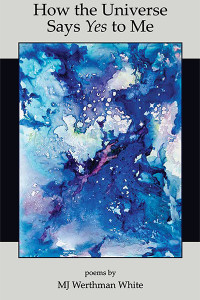
How the Universe Says Yes to Me, M. J. Werthman White, Main Street Rag Publishing 2017 (www.mainstreetrag.com)
How the Universe Says Yes to Me is a short book with a lighter take on the subject. A handful of the poems are simple list poems (most amusingly “Lies I’ve Told”), inviting the reader to draw the lines between the items.  It has a few very amusing poems where the universe itself is personified, including the title poem, and “The Universe Speaks,” in which the ways of the universe are hard to understand: I found these whimsical, somewhat surrealistic, and quite charming. Some of the poems are historical— “Tycho Brahe’s moose,” for example, is about a real moose that the astronomer Tycho Brahe really brought to parties; “For Alex, the African Grey Parrot” is an elegy for the death of the celebrated parrot of animal psychologist Irene Pepperberg, feaured (among other places) in Scientific American.

A Green Line Between Green Fields, Steve Abbott, Kattywompus Press 2018 (www.kattywompuspress.com)
A Green Line Between Green Fields is the only book of the four books here daring to venture into rhymed verse (although most of the work is unrhymed), with the rhyme (often slant) of “The Fool’s Boy” and “Trained.” I have to admit to an unabashed admiration for form— a twelve-stanza terza rima using only two rhymes (as in “The Fool's Boy") is not easy! “ The Torturer’s Daughter” ventures (obliquely) into political commentary; and “Pulling Yourself Up by Your—“ somewhat less obliquely. The title poem is a tribute to the late Maj Ragain, an anecdote showing his humor and wordplay, and a bit of his buddha-nature.

500 Cleveland Haiku, Michael Ceraolo, Writing Knights Press 2018 (https://writingknightspress.blogspot.com)
I have to admit to some degree of envy that Michael Ceraolo published this one first, since back in 2011, I published on the web my own haiku series, "52 Cleveland Haiku," with one Cleveland haiku for each week through the year (find it here, here, and here.).  So, Michael goes there and a few hundred more. His haiku (not to mention senryu, zappai, and various other 'ku forms) span the range from observations of the cityscape, to cynical observations about people and politics, very often focussing on observation of the many ways in which Cleveland is a very different city for the rich than for poor. He winds his way through the seasons of the city, watching with alternating compassion, passion, and scorn, celebrating the cracked concrete and the ice-covered lake equally.


poet Mary Jo White is from Xenia, OH
Michael Ceraolo is from Cleveland, OH
poet Steve Abbott is a native of Columbus, OH
Susan F. Glassmeyer is from Cincinnati, OH

Friday, September 7, 2012

Machine Gun Poets

In a recent article, Main Street Rag Editor M. Scott Douglas defends a new policy of his press to put, in their book contracts, a stipulation that the author will not publish with another publisher for at least nine months after publishing with Main Street Rag. His reasons for this can be found here.

It's always interesting to get a publisher's point of view, especially if that publisher is a poet themselves, on the business end of poetry and poetry sales. Also, I think Douglas makes some good points--trying to get a manuscript or book published everywhere as quickly as possible, especially when it comes to independent presses, not only hurts the poet, but also hurts the presses themselves. Douglas explains this more thoroughly than I can, so check out his article.

However, I think there are some things that publishers can do on their end as well. I remember speaking with a former teacher of mine who had been offered a contract by Knopf, and was debating leaving Greywolf. His issue was that he would get lost in the shuffle at Knopf, and while the money was there, the investment in the poet wasn't. I think independent publishers have this same issue, and it's pretty clear that for many publishers, there's a "here's your book, no go read and sell it" mentality, with little concern for how to advance the poet, the book, the readership, etc. Even something as basic as sending out press releases to local newspapers or information to bookstores seems to be lost on a lot of publishers, much to the detriment of the poets and the press itself.

An alternative to this is limited runs, but this brings up a different set of issues. How does a limited run affect the poet on the long term? Once they churn through that initial batch of 25, 50, 100, etc.--an easily accomplished task with tools like Facebook and PayPal these days, what happens? Is there a second release? Do they call it quits on that book until a "New and Selected" comes out? Do they collect three or four chapbooks and try to cobble them into a manuscript? Do limited edition chapbooks encourage machine gunning more than long term investment in a poet and their work?

As many readers of this blog are published poets, I'm curious to know how their publishers went about promoting their books, and the sort of relationship built up between publishers and poets. What do you think could be done to increase book sales? What do you think poets need to start doing? What do publishers need to start doing? What do the two of them need to start doing TOGETHER to change the game itself?

Cited...

The poet doesn't invent. He listens. ~Jean Cocteau