Showing posts with label speculative. Show all posts

Friday, July 4, 2014

Some Beautiful 'Zines

                                        Handbow.  Image by Smith, from The City
One thing about the new era of poetry 'zines published electronically is the full-color art.  Now, a great poem is a beautiful thing even typeset in black and white, but we are living in an era when 'zines are not merely text, but works of art, with images and poetry woven together.

I was thinking about this because a couple of 'zines I follow recently came out with new issues.

 Preeminent among local 'zines with poetry and art has to be Lady Smith's The City Poetry.  The summer issue, as usual, is gorgeous, with poetry (and art) by the Cleveland poets we're all familiar with.

 In the way of fantastical poetry, Goblin Fruit's Spring Issue recently came out.  Over the years Amal & Caitlyn have featured several northeastern Ohio poets; this issue has a poem by Mary Turzillo.

And, the summer 2014 issue of Astropoetica just came out, with the art and poetry of the stars.  Two of my poems reprinted here, but still, a bittersweet issue, since Emily Gaskin, the editor, says that it will be the final issue.  For ten years Astropoetica has been the premier showcase for stellar poetry, and I'll be sad to see it conclude its run.

NGC-6302, the Butterfly Nebula.  Photo by Hubble Space Telescope.
                                           Butterfly Nebula.  Photo by Hubble Space Telescope.
These are some of my favorites.  If you have your own favorite 'zines blending art and poetry, list them in the comments.

Thursday, February 13, 2014

Slices from a Silver Blade

The most recent issue of  Silver Blade Magazine has Mary A. Turzillo and me as the featured poets, including a couple of poems from each of us, and an interview with both of us by editor John C. Mannone.
And he says flattering things about us, too!

logo of Silver Blade

Sunday, January 26, 2014

Eye to the Telescope: Speculative Juxtapositions

Cleveland's Joshua Gage is the guest editor of SFPA's Eye to the Telescope web poetry-zine, for a theme issue "Juxtapositions in Speculative Poetry."  A half dozen poems, all in one way or another dealing with the theme of juxtaposition.
From Josh's introduction:

Juxtaposition is one of the basic and essential craft tools that every writer needs to master. It is also one of the most effective tools a writer can use because it forces the reader to contemplate new ideas and to place the familiar in new contexts. When used effectively, juxtaposition forces the reader to be complicit in the writing of the poem, forces them to participate in the logic and sense of the poem, creating a more fulfilling reading experience. Speculative literature thrives on juxtaposition, often asking readers to place the known and ordinary against the unfamiliar, the strange, and the fantastic. It is in these pairings, these juxtapositions, that the imagination flourishes and the reader is rewarded with new perspectives, new ideas and views on the world. The poems in this issue will, through juxtaposition, reward you in such a way.


Friday, July 26, 2013

Clevelanders in the Eye's Body


You wouldn't know it, but Cleveland is seriously a hotbed of speculative poetry.  The Science Fiction Poetry Association has just came out with issue 9 of their online journal of speculative poetry, Eye to the Telescope. Each issue is a theme issue, and the latest, with guest editor Catherynne Valente, has a theme of "bodies:"
In science fiction and fantasy, the body is a battleground, a liminal space, a canvas, a friend, an enemy, an object, a subject, a transitory state, something to be left behind, something to be embraced, something to be denied, something to alter. All our experience begins in the body, and poetry, with its vivid, deep language, has always been uniquely situated to express the complicated relationship between the possessor of the body and the body itself. 
The issue has poetry by two local poets, with two poems by Marie Vibbert, and two more by Joshua Gage. Congrats to Marie and Josh!

The SFPA also publishes the anthology Dwarf Stars once a year, with the best short-short speculative poetry of the year (full disclosure: I edited it last year), where "short short" includes haiku, senryu, cinquains, scifaiku, and other miscellaneous poems of ten lines and under.  I just received this year's Dwarf Stars volume yesterday, and see poems by Mary A. Turzillo, dan smith, and me.

You want to hear what short-short speculative poetry is about?  You're in luck: next month five of the Dwarf-star poets will be doing a reading from Dwarf Stars (both the last issue, and this one) at the Second Wednesday Poetry Reading, August 14 at 7pm at Mac's Backs.  Come at 7 for the feature; but stay for the round-robin poetry that follows!

Or, if you can't wait, you can buy a copy for $5.00 (plus two dollars postage) from SFPA.

Dwarf Stars. Cover Art: "Elephant" by neisbeis.deviantart.com

Sunday, February 3, 2013

Deep Cleveland features the Dwarf Stars: Friday

japanese text for scifaiku

This Friday, Feb. 8, the long-running Deep Cleveland Poetry Hour reading series will be featuring editors and authors of Dwarf Stars, an anthology of the best short-short speculative poetry of the year.  Every year, the Science Fiction Poetry Association awards the "Dwarf Stars" award to the best short speculative poetry of the year, where "short" is defined as "ten lines or fewer," and "speculative" means poems of science-fiction, fantasy, horror, surrealistic, or similar content.  The Dwarf Stars volume, which just came out, reprints the fifty best such short speculative poems of last year.
Cover of Dwarf Stars anthology
Cover Art: "Once Beyond a Time"
by overseer.deviantart.com
But, what does this have to do with Cleveland poetics, you might ask?  Well, as it turns out, this year the Dwarf Stars anthology was edited by two Cleveland poets: myself and Joshua Gage.  And the book contains, among others, poems by two Cleveland poets, J.E. Stanley and dan smith.  So the Deep Cleveland Poetry Hour is perfect for the debut of the anthology!

Should be a great night with some science fiction and fantasy poetry!
--anybody else out there write SF and fantasy?  Come on over!  We'll have an open mike!


Deep Cleveland is held on the second Friday of every month at the MugShotz Coffee Shop, 6556 Royalton Road North Royalton, Ohio; the event starts at 8, with the feature reading starting at 8:30 p.m.


Looking for a collection of scifaiku and other one-breath short-shorts that are science-fictional in the way of poetry?  The anthology will be for sale at the reading, or if you can't make it, it can be purchased from the SFPA for $8.00 plus $2.00 shipping (in the US).

Saturday, January 24, 2009

Book Review: Night Ship To Never

More than 250 poems
by Kendall Evans have appeared in numerous sf, fantasy and horror publications. He is the author of two chapbook-length poems, "In Deepspace Shadows" and "I Feel So Schizophrenic, The Starship's Aft-Brain Said." He is now at work on his own ring cycle of 4 connected chapbooks. In 2006 he and David C. Kopaska-Merkel shared a Rhysling Award for the best sf poem of the year (long poem category) for their collaborative poem, "The Tin Men".

David C. Kopaska-Merkel is the editor and publisher of Dreams and Nightmares magazine, and was for six years the editor of Star*Line, the journal of the Science Fiction Poetry Association. Fourteen previous chapbooks and hundreds of poems and short stories have been published in dozens of venues since the early 1980s. David lives in Tuscaloosa, Alabama, with 2 artists, 3 cats, 1 dog, 2 bunnies, and thousands of books.

These two poets recently published a collaborative collection, Night Ship To Never, from Diminuendo Press, an imprint of Cyberwizard Productions. This collection is a mixed bag of genres, primarily science fiction, but occasionally teetering into folklore and horror. There are eighteen poems in this collection, all illustrated by Richard Svensson.

At their best, these poems can be seen as cautionary, working with themes of science fiction or fantasy to ask and answer questions of humanity. For example, "I Am He As You Are They And We Are All Together" uses the metaphor of interspecies relationships and colonization to discuss and question the human need to belong, exploring what can be lost in pursuing this needs.


In the beginning the word was, I’m told,
We all wanted to be a part of something bigger
We sacrificed mobility but gained collective strength,
Our numbers covering a great deal of territory
In inner and outer space.
We colonized new worlds, made the aliens
A part of us, indivisible--
We were close.
Things began to get a little confusing
Admittedly, at times,
But it was worth it.
Why, communication is so much faster
Now that “we” have become “I”
High-speed analog connections
To everyone, everywhere
(sorry about the riffraff)
Shared libraries and data-collection ports―
But, you know, that “I go where you go” thing
It’s just not working, it’s getting a bit old,
I’m sick of the “you” part of “me”,
I want to be
Myself again
Alone and insufficient


However, in the same way that the genres of these poems are mixed, so too is the tone of the pieces. At times, it was difficult to balance the serious or exploratory poems with the playful and silly. It is hard to transition, in such a short space, from the introspective questions of poems like "Princess P, In A Spin" to the haunting darkness of "In Wicked Hollows, On Darkling Plains" to the silliness of "Robo-Cat®," which reads like an advertisement, including lines like:

At no additional charge, Robo-Cat® comes complete
With a framed pedigree certificate;
And no more need to “let the cat out” late at night
Your mechanical pet does not defecate.
But let it out of the house if you want to; Robo-Cat® won’t rust

Other Robo-Cat® products you will want to order immediately:
Decorative cat box with festively colorful kitty litter
(For ornamental purposes only; not recommended for living pets)
Cat bed fully wired for remote Internet access
Sturdy Mouse Cage, with metal bars and cat-proof lock
Protect your computer mouse from Robo-Cat® (strongly recommended)


While I have never been a fan of light verse, my issue is not with the tone of this individual piece, or any of the other poems. However, in such a short collection of only eighteen poems, the leaps between seem too great. Every poem is rendered well, but this collection doesn't hold together as well as I'd like.

Taken on their individual merit, these poems are solid. It is always difficult to critique collaborations, because usually one poet dominates the other, but it is extremely difficult to tell, in this collection, where Evans stops and Kopaska-Merkel begins or vice versa. This, for me, seems like a good thing; the two voices mesh seamlessly, and the pieces, as individuals, work well. Other highlights include the folkloric exploration of genetic manipulation in "Dragon's Teeth" and the discussion of questions concerning artificial intelligence in "Death and Life on Enceladus".


Sunday, January 18, 2009

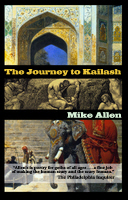
Book Review: The Journey to Kailash

Mike Allen has been, for nine years the editor of the biannual poetry journal Mythic Delirium. He's also edited or co-edited several books, including The Alchemy of Stars (the anthology of all the poems which have won the Science Fiction Poetry Association's Rhysling Award) and the MYTHIC anthologies of fantasy poetry and fiction. He's published four books of poetry, and his latest, Strange Wisdoms of the Dead, was a Philadelphia Inquirer Editor's Choice selection. He's a former president of the Science Fiction Poetry Association and a three-time winner of the Rhysling Award.

His newest book, The Journey to Kailash, was published by Norilana Books as part of their Curiosities series. It is a three section book, each section about 30-40 pages. These three sections create a vivid journey for the reader through fantastic, often dark, stories.

The first section, "misfortune when he leaves: his shadows grow to meet her," seems very fantasy oriented. For example, the primary and eponymous poem of the collection begins


When Ganesh marries my mother,
I am 18, my own man
in the eyes of the law; but barely a zygote
in his eyes. He calls me spermling
the first time we speak in private;

the poem continues through a step-father/son relationship, and journeys into the territory of what it might mean, in this day and age, to marry a god.

Perhaps my favorite poem of the section is "Giving Back to the Muse," which is a lesson in sacrifice, or love, or something else, perhaps... It begins:


She wears a necklace of knives and eyes,
a sash sewn from flags and faces,
boots welded from bomb fragments,
a belt of hangman’s rope.

and gets even more juicy as the poem rolls forward.


The second section of The Journey to Kailash is "as the stars die, sad whispers warm the breeze," which seems very science fiction oriented. In "Manifest Density," we colonize the universe, bringing "Slurpee cups and no U-turns" to the brink of extinction. In "Black Holes Hold Their Breath," the speaker responds to a comment made by Stephen Hawking concerning black holes and time travel. "retrovirus" takes iconic figures and creates a nightmarish world of 1950's imagery. However, the uninitiated reader should not be afraid. Even though these poems are scientific in nature, and even though Allen drops a few S-bombs (science words that need googling), he keeps the poems extremely accessible, and any reader will be able to connect with the characters and smile or shudder along with the stories told.

The third section of the book is "staring down the sun: the end he never sees," is a more surrealistic series, the majority of which is focused on artists, the worlds they created in their art and the events that inspired them, from "Escher's Bed" to "Klee's Garden" to "O'Keefe's Bones." This is one of the more difficult sections of the book, not in terms of accessibility, but in terms of tone and heaviness. This is a very resonant section, and readers should absorb Allen's words slowly if they are to survive.

The Journey to Kailash is not the book for every reader, certainly. There are elements of the fantastic, elements of science fiction, even elements of surrealism all rubbing against each other. There are times when the disparity seems too great, and this becomes a collection of three chapbooks, but Allen manages to tie it all together, whether through a recurring image or the evocative mood of the poems. In this bitter season of negative degree weather, Mike Allen's The Journey to Kailash is a wonderful book to accompany a pot of tea before of a smoldering fire.


Monday, August 11, 2008

Supersale on The Shantytown Anomaly...

The Shantytown Anomaly is a 20 page chapbook journal featuring Sci-fi/Fantasy/Horror poetry, scifaiku, articles and the occasional short-short story. In celebration of their new website, they are having a huge sale. Each issue is normally $3-4, but right now you can buy five issues for $5!!! This is a huge deal, and an opportunity to get a lot of great poetry for a really low price, including issues featuring Dwarf Star nominated poetry, and a Rhysling Award winning poem.


Currently, the issue I have is number three. This is a GREAT issue of speculative poetry. There are some very dark horror poems, some well crafted formal poems, including three pieces by Rich Rostow that are combinations between villanelles and triolets. There are also two pages of scifaiku--short poems that resemble haiku, but use science and scifi words instead of kigo. There is also a short prose piece from Lee Clark Zumpe.


My favorite piece in this issue has to be "Future Macho," by Marcie Lynn Tentchoff. This is a great poem about men becoming obscolete, and what happens when they (we?) do. Just the opening stanza causes a wry smile to cross the reader's face:


He keeps it on his bathroom shelf,
bottled, stored away in brine,
like
some obscenely sculpted pickle,
and shows it off at parties, grinning,
winking vulgarly at all of us who've
seen it far too many times before.


I strongly recommend readers and fans of poetry visit The Shantytown Anomaly's new homepage, and take advantage of this incredible deal.

Cited...

The poet doesn't invent. He listens. ~Jean Cocteau