Here they are, the ten finalists and three alternates for the 2nd Annual Best Cleveland Poem Contest. Come to the Willoughby Brewing Company at 4pm this Sunday to hear them read, orchestrated Master of Ceremonies Ray McNiece.
Please invite one or two hundred of your friends to support this event sponsored by Tim "I'll make them rhyme" Misny.
In no particular order:
Steven Smith
TM Göttl
JP Armstrong
Dianne Borsenik
Jeffrey Bowen
Lee Chilcote
Renay Sanders
Michael Murray,
Geoffrey Landis
Danilee Eichhorn
Anita Keys
Mary Turzillo
Frances Lograsso
This will be great!
See you all Sunday. Please promote the event on fb, twitter and other media platforms!
Bottom Dog Press has released two new books by Cleveland area writers: Robert Miltner's And Your Bird Can Sing: Fictions (flash fiction, each to the title of a Beatles song) and Larry Smith's Lake Winds: Poems (works of nature, family, friendship, and faith set along the lake land). These are both seasoned writers who have done the work of keeping literature alive in our region not just as writers but as teachers and organizers. Bottom Dog Press Homepage
On The Atlantic, MicahMattix asks, Have you ever tried to sell a poem on Craigs List?Aaron Belz has.
"Poet available to begin work immediately. Capable in rhyme and meter,
fluent in traditional and contemporary forms. Quotidian observations
available at standard rate of $15/hour; occasional verse at slightly
higher rate of $17/hour. Incomprehensible garbage $25/hour. Angst
extra."
"When you're at a party, a family gathering, a wedding, a bar-wherever
people might ask you about life as a poet, be honest: tell them about
your work. Don't self-deprecate. Defend the countless hours, the
late-nights wading through submissions, the pain and glory of rejections
and acceptances. Tell them about why you write, why it matters and why
it has an impact. Don't settle for hobbyist because it's easy to
explain... Tell them that poets aren't all wimpy and sad"
Here's the scene of the crime: the RTA station at West 117th and Madison in Lakewood, Ohio, on Cleveland's west side, in broad daylight, between 11 AM and 11:30 AM.
It all started with a poetry book, Mosaic by Ohioan Margie Shaheed, published by NightBallet Press in June, 2013. In the months since NBP published her book, Margie has sold an average of 40 books a month, for a total of well over 500 books. I have an admittedly hard time keeping up with her demand!
It was no different this month. With the Ohioana Book Festival coming up tomorrow (May 10th) in Columbus, Ohio, Margie needed 50 books for her appearance and signing there. All book sales have to go through Barnes & Noble for Ohioana, but since B&N doesn't carry Mosaic, I needed to physically get the box of books to her. We arranged to meet midway between our residences, at the RTA station.
I saw her bus pull up as I turned into the RTA parking lot in my car. At the same time, she phoned me to say she was there. I parked at the end of one of the rows and started walking toward her. She was easy to spot in a dandelion-yellow shirt and headscarf. I saw her put out her cigarette on the concrete, and she walked toward me. She couldn't have taken more than a puff or two on the cigarette; there hadn't been enough time for her to do so.
We embraced, and started talking about Ohioana. I gave her the box of books and she gave me the money she owed me for her last shipment of books. I wrote her a receipt. We continued to talk animatedly about Ohioana.
We had been talking for about ten minutes when It Happened. The RTA cop, who had been sitting in his car in front of the station, swaggered over to us. Without so much as an "Excuse me, Ma'ams", he aggressively interrupted our conversation, addressing only Margie: "I KNOW you saw the sign because you were sitting right under it." Margie said "What?" He repeated his statement, then he said it was the "No Smoking sign". Margie tried to say she hadn't immediately seen the sign and that she put out her cigarette as soon as she saw it, but the cop wouldn't allow her to complete a sentence. He interrupted her and took a very confrontational stance, like she was backtalking him. She wasn't. I was right there next to her. She was polite to him and never raised her voice. She said she put out the cigarette. He threatened her with a $250 fine. I couldn't believe what I was seeing and hearing. I wish I had thought to turn on the video on my phone. He finally blustered and turned on his heel to go. I thought it was over.
It wasn't. He turned back to her (mind you, he never once glanced at me or addressed me in any way...but maybe the paleness of my skin made me blend into the background. Yeah.) and once more started in on her: "Do you have a vending license?" He indicated the box of Mosaic I had just delivered. "Because you're selling without a vending license!" She said "I'm not selling anything," and he said "I saw money exchange hands!" Again, he's being very confrontational and nasty. Keep in mind that I am the one who "sold" her the books, so he should have been addressing me. She responded that he was looking for something to get her for, and she was right. It was escalating fast, and Margie was visibly shaken. I had tried to stay out of the conversation up to this point, as there was no point in agitating the bully cop any more, but it was time for me to step in. I pointed out to the cop that I was her publisher and that she was "my star seller, and an important part of tomorrow's "big book festival down in Columbus". I told him she had owed me the money (true) and that no transactions were taking place on RTA ground. He then addressed me (in a much nicer tone than he had addressed Margie) that he was "just trying to keep an eye on crime". Liar. What he was doing was committing a crime. He was obviously rousting Margie because of her skin color. I've heard about things like this happening before, but it's the first time I've actually seen it.
This is the bully who harassed us at the RTA station.
I was ready to tell him to go ahead and arrest me for the illegal sale of Mosaic to Margie, but when he saw that I was involved and that we were sticking together in the incident, he backed off and the Perp Who Committed the Crimes of Indecency, Racism, Rudeness, Ignorance, and Harassment swaggered away, free as a bird.
A number of local poets took up the challenge of "A Poem A Day" for the duration of April, National Poetry Month. Some responded to challenges and prompts--such as the CCPL's poetry prompts, Robert Brewer's "Poem-A-Day" prompts or Writing Knights superhero challenges-- and some just took the challenge of writing a new poem every day for the month.
Marie Vibbert took Robert Brewer's "Poem-A-Day" challenge, where he posted a daily prompt on his "Poetic Asides" blog. Here's her poem from Brewer's Day 1 prompt, "write a beginning poem/write an ending poem": Unlooping
I'm living a black vinyl record
And you gave me a scratch.
Every year I hit your chord.
What's past is future is passed.
It's an unwanted time travel catch.
At least we're spiraling inward - Your impact fades with each pass.
Time is all travel and life is scored With tragedies lost and dispatched And all the things we forget to record - What's passed is future is past.
--Marie Vibbert
Marcus Bales also took up the challenge of a poem a day, posting each one to his wall on Facebook. Here's his poem for day 18 of the challenge: On the Bus She swayed with unexpected grace Along the pitching bus Indifferent to the brutal race Aroused in each of us. Her cotton dress was of that bare Beyond unbaring kind – She pressed against the lucky air And trailed her scent behind. She didn’t speak, but we could hear A lyric siren sing, And our most lurid dreams were clear In wild imagining. You couldn’t hear a sneeze or cough Among that motley lot Til moments after she got off – As we, of course, did not.
--Marcus Bales
John Clarke was taken by this one enough to put it to music. You can see a video of him playing the song version.
Of course, with the press of time, poems from the poem-a-day challenge sometimes are a little rough. My technique was to just write, don't think. Or at least, that's my excuse, and I'm sticking to it. I didn't even make half of the quota for poem a day, but here's my poem for Brewer's Day 24 prompt, which was to write a poem titled "Tell it to the (Blank)": Tell the Mountain
Tell your woes to the birds in the air, tell the ravens, tell the sparrows. The birds will fly to the edges of the Earth, and carry away your sorrows. Tell your tale to a stranger on the street, and listen to his own; your stories are both different, your stories are the same, your lives are both unknown. Listen to the wisdom of the flowers of the field, the blowing of the wind; the buzzing of the bees and the ripple of the brook, the knowledge that the world has an end. Go tell your sorrows to the graveyard on the hill, to the folk sleeping there; in the silence of the cool grassy meadows, they listen without care. Shout your love into the sighing of the storm, to rain and sea and sky; the wind will listen, the wind will hear, the wind will give you your reply.
--Geoffrey A. Landis
Did you do the challenge this month? If so, pick one of your challenge poems and post it in the comments, and I'll post it here.
The Guide to Kulchur, a text, art and news store on Cleveland's West
Side, will turn a year old in June -- something of an achievement in
itself in this era of shrinking independent bookstores. R A Washington, a
poet and
musician, runs the bookstore, which is just north of the Capitol Theatre
on W. 65th St. R A talked about the Guide to Kulchur with the
Plain Dealer's Michael Heaton -- our Minister of Culture.
On Grub Street, Lisa Borders says writing advice is like dieting advice: it sounds easy.
"It sounds so easy! Just have that discipline, get up a couple of
hours before you need to deal with the rest of your day, and write. This
is the kind of advice often given to writers: early morning writing
hours, daily word or page counts, stringent deadlines. It reminds me of
nothing so much as the myriad diets I’ve been on over the years: the
enforced exercise, obsessive point or calorie counting, weekly weight
goals. "We all know what happens with most diets: we fail at them. And as we
fail, we feel even worse about ourselves than we did when we began. "As with diets, I think this strict writing advice many of us take as gospel can lead to a similar negative feedback loop...."
I've been posting shout-outs to the Cuyahoga County Public Library's National Poetry Month "30 Days of Poetry" site a lot in the blog, because they have been doing a great job of showcasing poetry from Cleveland and the surrounding area.
But I just have to mention today's featured poet, though, simply from a purely self-promotional standpoint: today they feature a poem by me.
And do make a point of checking out the "Read a poem" feature on the 30 Days of Poetry site: every day a new poet from Northeastern Ohio.
This was the end of the second week of National Poetry Month, and that means "A Poem A Day" challenges from all quarters. The Cuyahoga County Public Library's "30 Days of Poetry" features a new poetry prompt every day, Robert Brewer's Poetic Asides is doing the "Poem-A-Day" Challenge, and Writing Knights is posting a superhero challenge every day on their facebook page
I know of at least two poets in the area-- not counting myself-- who have taken up the gauntlet of the National Poetry Month "A Poem A Day" challenge.
Anybody else?
Come on, let's share! Post one of your challenge poems in the comments (or e-mail it to me), and I'll post it here.
The Cuyahoga County Public Library's "30 Days of Poetry" has been doing an great job in showcasing poetry from Cleveland and the surrounding area (including quite a few who contribute to this blog.) I hope everybody's following along!
Today's featured poet is worth a special note, though. In addition to being a poet, a teacher, and a tireless traveler, Michael Salinger has one other accomplishment that's worth highlighting here in particular: he started Clevelandpoetics: the blog. So, if you read this blog to catch up on what's going on in the poetry scene (or just to pass the time)-- thank Michael.
And do make a point of checking out the "Read a poem" feature on the 30 Days of Poetry site: there are some amazing poets in the area.
so thick
they were snow-shoveled
from the sidewalks on public square
my grandfather called them Canadian soldiers
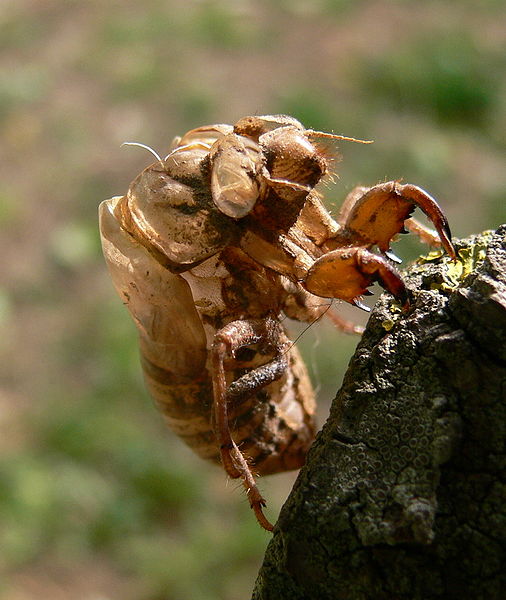
but the thumb-sized black and green bugs
hadn’t flown across lake erie
they clawed up from the soil
after seventeen year sleep
claim staking the world
for ten summer days
filling the stagnant air with static
then they died
leaving
empty shells
translucent chrysalis
split along the back
clinging to trees
and brick wall
their bodies
crunching under foot
and bus tire
downtown in front of higbee’s
a doorman in a red coat
yellow trim at the cuffs
polished shoes
clears the entry
scrape of steel on concrete
white swath cutting through
the buzz-clicking mass
as if shaving a living beard
years ago
back when
playing with
mercury
on the black-and-white-checkered
asbestos-tiled kitchen floor
was not yet
dangerous
"Cicadas" by Michael Salinger in I Have My Own Song for It: Modern Poems of Ohio edited by Elton Glaser and William Greenway, Akron University Press, 2002. Used with permission of the author.
Michael Salinger is a father, poet and educator who travels the world
promoting the use of poetry as a literacy tool in classrooms.
"Can you describe the mood of Cleveland as you feel/see it?
"Cleveland is like being in the heart of a machine. I spent most of my
life trying to leave. Growing up, I would have and did do anything to
“get out.” It was like that place in a song; the place you get stuck in.
Think Tracy Chapman. Gray and backwards, it was a place where people
circled the wagons and resisted change.
"I have been back now since the
summer of 2012 after several years “away” in other cities. I have been
across the world, and I now see how I was so very wrong about Cleveland...."
Rereading and reexamining Tim Seibles's "An Open Letter," I'm caught by the line "What the hell happened to the notion of poet as town crier,
rabble rouser, shaman, court jester, priestess, visionary, madman?" I'm wondering if, after attending a few open mikes, teaching a few classes and reading a few books from the library, poets haven't forgotten their responsibility. There seems to be an aesthetic of "clever" that permeates a lot of poetry today--poetry that says little, but works on some level as a joke or entertainment. While this may work to sell poems, and appeal to a wide audience, I'm wondering if it doesn't detract from the purpose of poetry as a whole. I'd like to urge poets to consider the responsibilities they have to their readers and to their communities as a whole, and challenge them to take up the mantles that Seibles calls for.
Town Crier
A town crier was an official court position in the 18th century. They were elaborately dressed men who would ring a bell in the town square, and make official proclamations from the court.They would also bring the news to the people, as the majority of the population was illiterate. The traditional cry of the town cryer was "Oyez!" which is the name of a literary journal out of Roosevelt University. Considering the social and cultural illiteracy that permeates our country, that so many get their news through 30 second sound bites between Top 40 hits on the radio and allow it to grow and fester through rumor, I'm wondering if more poets couldn't take up this mantle. Williams writes, "My heart rouses/thinking to bring you news/of something/that concerns you/and concerns many men. Look at/what passes for the new./You will not find it there but in/ despised poems./It is difficult/to get the news from poems/yet men die miserably every day/for lack/of what is found there." Where are the poems that men are dying for the lack of? Why aren't we writing these poems? Rabble Rouser A rabble rouser is one who excites or inflames a group of people into action, who appeals to the emotions and values of the group to spur them into acting. What is important about a rabble rouser is that they appeal to the EMOTION of the people via rhetoric, not the LOGIC of the people. Where are the poems and poets that are appealing to our emotions, that spur us into action? Where are the poems that challenge and usurp the ochlagogues that permeate our televisions and radios?
Shaman A shaman is a religious figure that reaches altered states of consciousness through ritual to enter the spirit world. There, they deal with spirits, both good and bad, and channel these energies and messages back into this realm. Often these messages are those of healing or prosperity, the shaman having been asked to deal with a specific illness or malevolence plaguing an individual or the tribe in general. Our world is faced with so much suffering, so where are the poems of healing? Jerome Rothenberg's anthology, Technicians of the Sacred, is filled with poems from shamans. What can we, as poets, learn from these ancient texts? Court Jester Traditionally, there are two types of jesters or fools: the natural fool and the licensed fool. Natural fools were those who, through some illness or ailment, would act inappropriately. According to Allison Chaney, "The fool's status was one of privilege
within a royal or noble household. His folly could be regarded as the
raving of a madman but was often deemed to be divinely inspired. The
'natural' fool was touched by God." The licensed fools were trained individuals who were given leeway by their master to act in such a way. In the case of the licensed fool, their role was not merely entertainment, but one of critic. In either case, the jester operated outside of the bounds of society's rules and regulations, and their words were seen not as madness, but as wisdom. Often speaking in riddles, the fool criticized the prevailing social order and challenged status quo. So where are our poems that work as riddles to challenge and critique? How can we use divinely inspired madness to work outside the social order and challenge it's foundations? Priestess If the Court Jester can be seen as "The Fool," the first unumbered card of the major arcana, then the High Priestess is the third card, numbered as "2". She is seen as a visual representation of Shekhinah, or the female embodiment of the Divine. Interpretations vary, but often she represents a secret being revealed, often through wisdom, sound judgement or common sense, or even intuition. Where, then, are the poems that split open the secrets which are being kept, which reveal the truth through common sense and wisdom for the reader? Visionary A visionary is one who has visions. Often these are visions of events to come, or the future. Mystical poets and prophets probably fall under the heading of "visionary." There is even a style of art called "visionary art" that purports to "transcend the physical world and portray a wider vision of awareness including spiritual or mystical themes, or is based in such experiences." If there can be such a thing as visionary art, then why not visionary poetry? In his poem "America," Allen Ginsberg writes " I have mystical visions and cosmic vibrations." Where are the poems of vision, of the future? Where are the poems that prophecy? Madman d. a. levy, in "The Cleveland Manifesto of Poetry," writes that poets should "create new myths, madness and mass from the contemporary waste of intellectual energy." Madness is associated with the insane, but how is that insanity defined? Folks with diseases--clinical depression, bi-polar disorder, anxiety disorder, schizophrenia, etc.--are all seen as unwell, mentally and emotionally, by the status quo. While we have visions of madmen struggling against their straitjackets, locked in padded cells and frothing at the mouth, all too often madness is simply seeing the world in a new or unique way, a way that challenges the status quo so thoroughly that it is seen as threatening. Where are the voices, then, that rise up from what levy sees as "the contemporary waste of intellectual energy" and, through their madness, bring about change for the reader? It is no longer enough to be safe. Is is no longer enough to be cute or clever. Readers thirst for a poetry that will revitalize and rejuvenate them, not merely fill them for the moment. We poets can no longer be stand up comedians, entertaining our readers with the literary equivalent of Twinkies. We can no longer gaze at our navels and expect that the drudgery of our lives will be so profound as to shake a reader from their own drudgery. We must be better before we fade into oblivion completely.
My heart rouses
thinking to bring you news
of something
that concerns you
and concerns many men. Look at
what passes for the new.
You will not find it there but in
despised poems.
It is difficult
to get the news from poems
yet men die miserably every day
for lack
of what is found there. - See more at: http://www.poets.org/viewmedia.php/prmMID/15541#sthash.RoQgCdqw.dpuf
My heart rouses
thinking to bring you news
of something
that concerns you
and concerns many men. Look at
what passes for the new.
You will not find it there but in
despised poems.
It is difficult
to get the news from poems
yet men die miserably every day
for lack
of what is found there. - See more at: http://www.poets.org/viewmedia.php/prmMID/15541#sthash.RoQgCdqw.dpuf
My heart rouses
thinking to bring you news
of something
that concerns you
and concerns many men. Look at
what passes for the new.
You will not find it there but in
despised poems.
It is difficult
to get the news from poems
yet men die miserably every day
for lack
of what is found there. - See more at: http://www.poets.org/viewmedia.php/prmMID/15541#sthash.RoQgCdqw.dpuf
My heart rouses
thinking to bring you news
of something
that concerns you
and concerns many men. Look at
what passes for the new.
You will not find it there but in
despised poems.
It is difficult
to get the news from poems
yet men die miserably every day
for lack
of what is found there. - See more at: http://www.poets.org/viewmedia.php/prmMID/15541#sthash.RoQgCdqw.dpuf
Don’t Laugh! (Out Loud) The Poetry of Joe
Toner and Dan Rourke
Being pretentious, dreary and inscrutable—all
at the same time—is a lot of hard work. These two local poets take the easy way
out. Despite their education, these veteran schoolteachers prefer to write
sweet, breezy verses that can be appreciated by anyone with an ear for a
well-turned phrase and a feeling for the beautiful little twists and turns of
life. Joe, who claims to have roller-skated from Minneapolis to Cleveland, also
claims to have read poetry with Dan at the Shaker Library’s Poetry in the Woods
program for the last ten years. “We’d like to bring our poetry to Lakewood so
that our west side friends can scratch their heads with the same vigor as our
east side friends.” Dan, a former English teacher, former magazine editor and
former employee of a surprising number of defunct bookstores, is the proud
author of a series of breathtaking, unpublished novels. While both are known for
making even the hardest-hearted critics of poetry crack a smile, Dan specializes
in the linguistically astonishing as Joe gives himself over to the absurd.
Bobbleheads of Ovid will be given away to the first fifty audience members who
realize that this is a joke and that there will be no free
giveaways. Tuesday, April 15 at 7:00 p.m. in the Main Library
Auditorium
On the Flyleaf: Herbert Woodward Martin
Celebrates Poetry and Song
Poems are nothing more than songs.
Songs are simply poems sung. These simple truths form the essence of Herbert
Woodward Martin’s beliefs and craft. Martin is perhaps best known as a scholar
and performer of the pioneering African American poet Paul Laurence Dunbar’s
works— performances that he’s taken as far west as Chaminade University in
Hawaii and as far east as The Alexandrine Library in Egypt. He's also the
celebrated author of eight volumes of poetry. In this program, Martin will both
demystify verse and praise its virtues. First, he will give an impromptu
demonstration of how to write a poem using words supplied by the audience. Then
he will discuss the legacy of the Dayton born Paul Laurence Dunbar. Dunbar only
lived thirty-three short years, barely glimpsing the dawn of the twentieth
century, but his verses have proved enormously influential. Martin will perform
some of these pieces, blurring the line between recitation and full-throated
song. Any skeptics who might be in the audience will have the dust blown off
their preconceptions when they are confronted by the power, rhythm and humanity
contained in a sequence of mere words, read with conviction and unabashed
reverence. This is a program that you simply must witness. Books will be
available for sale and signing at the event. Thursday, April 17 at
7:00 p.m. in the Main Library Auditorium
Water’s Footfall: The Poetry of Sohrab
Sepehri Presented by Dr. Mohammad Jafar
Mahallati
Sohrab Sepehri was born in 1928 on a journey between
Kashan, his family's home, and Qum. An acclaimed painter, Sepehri published
eight books of poetry during his lifetime and traveled widely throughout the
world, including Europe, South Asia, the Middle East, China and Japan, the
United States and South America. Many of his poems were influenced by his
relationship with nature and his studies of Eastern philosophy and visual arts.
They were often composed in a cadence similar to spoken language, considered a
radical innovation at the time. Sepehri died in 1980 and in Iran is considered
to be one of the most important poets of the twentieth century. Pierre Joris
described Sepheri as, “a modernist Muslim for whom the black stone of the Kaaba
was the sunlight in the flowers. He tried to invent a world in poetry and a
poetry in the world as had not been seen since the Nishapur of Omar Khayyam. He
made it new, indeed—writing a poetry that is a geometry of breath from which
music grows, with its cargo of light.” Mohammad Jafar Mahallati, one of
Sepheri’s English translators, is currently Presidential Scholar in Islamic
Studies at Oberlin College. He served as Iran's ambassador to the United Nations
from 1987 to 1989 and successfully negotiated a peace agreement to end the war
between Iran and Iraq. His scholarship has focused on Islamic and Sufi poetry
and most recently on the philosophy of friendship. Books will be available for
sale and signing at the event. Wednesday, April 23 at 7:00 p.m. in
the Main Library Auditorium
Weather by Dave Lucas
In this debut collection,
named winner of the Ohioana Book Prize in 2012, Dave Lucas turns and returns to
Cleveland. The weather he writes about arises from the lush light of the natural
world and the hard rain of industry. Poem by poem, Lucas surveys the majesty and
ruin of landscape and lakefront, paying tribute to the shifting seasons of a
city, of a terrain, and of those who dwell there. “I love our weather. There's
always a moment in the winter when I'm sick of it and a moment sooner in the
summer. But I love the steel look to the sky in winter. It makes our few days of
crystal blue in spring and fall all the more worthwhile. I use the word weather
as a verb. This city is weathering the storm. The town has been beaten down, but
many Clevelanders take that as a point of pride. Like the coffee mugs say,
‘Cleveland: You gotta be tough.’” Books will be available for sale and signing
at the event. Wednesday, April 30 at 7:00 p.m. in the Main Library
Auditorium
A Lyrical Life: Reflections
on Life-Journeys through Poetry and Song Presented by Rabbi Enid
Lader
Explore your own life journey through poetry in this four-week
program presented by Case Western Reserve University. The roads upon which
you've traveled are marked by steps still to be taken. Rabbi Enid Lader will
lead a discussion of poetry and song that beckons us to reflect on what it means
to think of our lives as a journey and how the text of our lives reflects our
values. We will explore the questions of what we want to pass on to the next
generation and what is in store for us in the future. Rabbi Enid C. Lader has
served the Beth Israel -The West Temple congregation since August, 2012. Active
in the Educational Director's Network, Enid also served in various capacities on
the regional board for the Union of American Hebrew Congregations (now the Union
for Reform Judaism) and has taught the west side Taste of Judaism and Feast of
Judaism classes for the Jewish Education Center of Cleveland for over twelve
years. Thursdays at 7:00 p.m. in the Main Library
AuditoriumApril 24, May 1, May 8, May 15
I recently met Robert Coughlin at the poetry series Words and Wine in Painesville, Ohio. He and series emcee Margie DeLong have asked me to get the word out about this poetry competition.
The 27th Annual
Poetry
Competition For Students
and Community Members
Category 1 – High School Students 1st prize -- $40
2nd prize --
$25 3rd prize
-- $20
Category 3 – General Public 1st prize -- $40
2nd prize --
$25 3rd prize
-- $20
· There will be a $5.00 fee with your entry, payable to
Lakeland Community College. ·
Submissions will be accepted until
Friday, April 18, 2014. ·
Prizes and certificates will be
presented at the awards ceremony at the Lakeland Library, C-3051, 7:00 p.m., on
Tuesday, May 6, 2014. · Winners will be invited to read their work at the
awards ceremony. · Winning poems will be published, with your
permission, on the internet.
Each entrant
will submit 1 to 3 poems to one category. No single poem should be longer than 2
typed pages. Entrants should include a separate sheet with name, address, phone,
category, and titles of the poems. No personal information should appear on the
poems themselves. Manuscripts will be returned if entrants supply a
self-addressed stamped envelope. The competition is not open to Lakeland
employees, but family members are welcome to submit.
On February 28, 2004, poet Tim Seibles penned "An Open Letter," a rant and call to arms for poets everywhere. He ends with this: "I
pray that those with the necessary instruments will soon bring the
right noise." While not explicit, I've always seen this as a possible allusion to Public Enemy's 1987 single "Bring the Noise" which later appeared on their album It Takes A Nation of Millions to Hold Us Back.
Much has been written about rap as poetry ("Bring the Noise" stands as an excellent example of dactylic meter and is rich with rhyme, allusion, and imagery), and I do not wish to pursue that topic. What interests me is the alternative--poetry as rap. Many MCs refer to themselves as poets, or refer to their lyrics as poetry, but very few of them come from a background of poetry first, and I'm wondering if this wouldn't help revitalize both poetry and the hip-hop community, and help to bring poetry to a wider audience.
The obvious precursors are performance poets, specifically those of the 1960s (The Last Poets, Gil Scott-Heron), who infused poetry with music on albums that sold quite well. Other examples include NuYo Records/Mouth Almighty run by Bob Holman in the 1990s. However, these examples are few and far between, and more often than not, the Grammy category of "Spoken Word" is bereft of poetry in its nominations.
Why is this?
The first, and most obvious argument is that "poetry doesn't sell." Labels don't put out poetry CDs because poets aren't famous enough to sell them, which leads to a dearth of options for the consumer public. I question this argument because CD (and now mp3 and other digital formats) have become so easy that anyone with access to a decent computer can put together a few tracks.
The other argument, and one that I think bears some merit, is one of promotion. Poets are notoriously poor at promoting themselves and their art. Famous for it, even. While albums and books often have media campaigns--advertising, videos, etc.--poets and poetry seem to relegate themselves to live sales only. Beyond gigs at coffee shops and bookstores, and possibly a facebook announcement or similar, we do very little to promote ourselves in the way that other artists, specifically musicians, do.
However, there are exceptions, and I think we can learn from these poets. One that comes to mind is the slam poet Black Ice, who released an album in 2006 on Koch Records. Originally a slam poet, he was noticed by Russell Simmons, performed on Def Poetry Jam for five seasons, starred in the Broadway production of the show, and in 2004, broke into hip-hop by featuring on two albums. In 2006, his own album The Death of Willie Lynch was produced. While a majority of the album is straight forward rap, there are a few tracks that feel less like rap and more like poetry. For example, "The Ugly Show," which Black Ice originally performed as a poem, is performed on the album with a strong beat. However, Black Ice often flows off beat, performing the poem as one would a poem, then brings it back to the rhythm of the music:
While his album The Death of Willie Lynch would probably be ignored as spoken word and seen as rap, it does show the potential that poetry can have to reach a wider audience than simply those who are used to coming to poetry readings.
At the beginning of National Poetry Month, I am caught up by the wave of poets and the flurry of activity on social media focused on poetry. Libraries are offering poetry programs, poets are offering "poem a day" challenges, and poets are filling their blogs and Facebook pages with new work. This is exciting, to be sure, and I would hope that this energy continues beyond April, but I constantly find myself wondering if it's getting to the right audience. How can we take this energy and this work, and bring it to the wider public? What can we learn from other genres, such as rap, in terms of marketing and promotion? What are your thoughts?
It's worth checking out. Sign up, or just bookmark their page, but be sure to check for something new every day for the next thirty days.
Meanwhile, the Lakewood library will also be featuring readings and events. Stay tuned for more info, but as a starter, at 7 pm today, the Lakewood library will celebrate a new posthumous collection of the works of Kent poet and bartender Mort Krahling. Maj Ragain, Brooke Horvath and Larry Smith will be among those joining the celebration of this rare, self-contained man. More at the Lakewood library web page.
Farther away from Cleveland, over at the "Poetic Asides" page on the Writer's Digest blog, Robert Brewer has the 7th annual April PAD (Poem-A-Day) Challenge: 30 days, 30 prompts. For this year's challenge, the top poem for each day's prompt will be published in a slick anthology, selected by an all-star cast of guest judges, including Thomas Lux, Barbara Hamby, Bob Hicok, Traci Brimhall, Jericho Brown, Sandra Beasley, Amy King, and more than 20 others. Find each day's prompt on the Poetic Asides home page.
And, lots of other stuff going on during poetry month-- celebrate by going to a local poetry reading! Keep an eye on the Cleveland poetry calendar (at the top of the page), or if you know of other events, post them in the comments--



+Bilgere+at+CPL.jpg)


